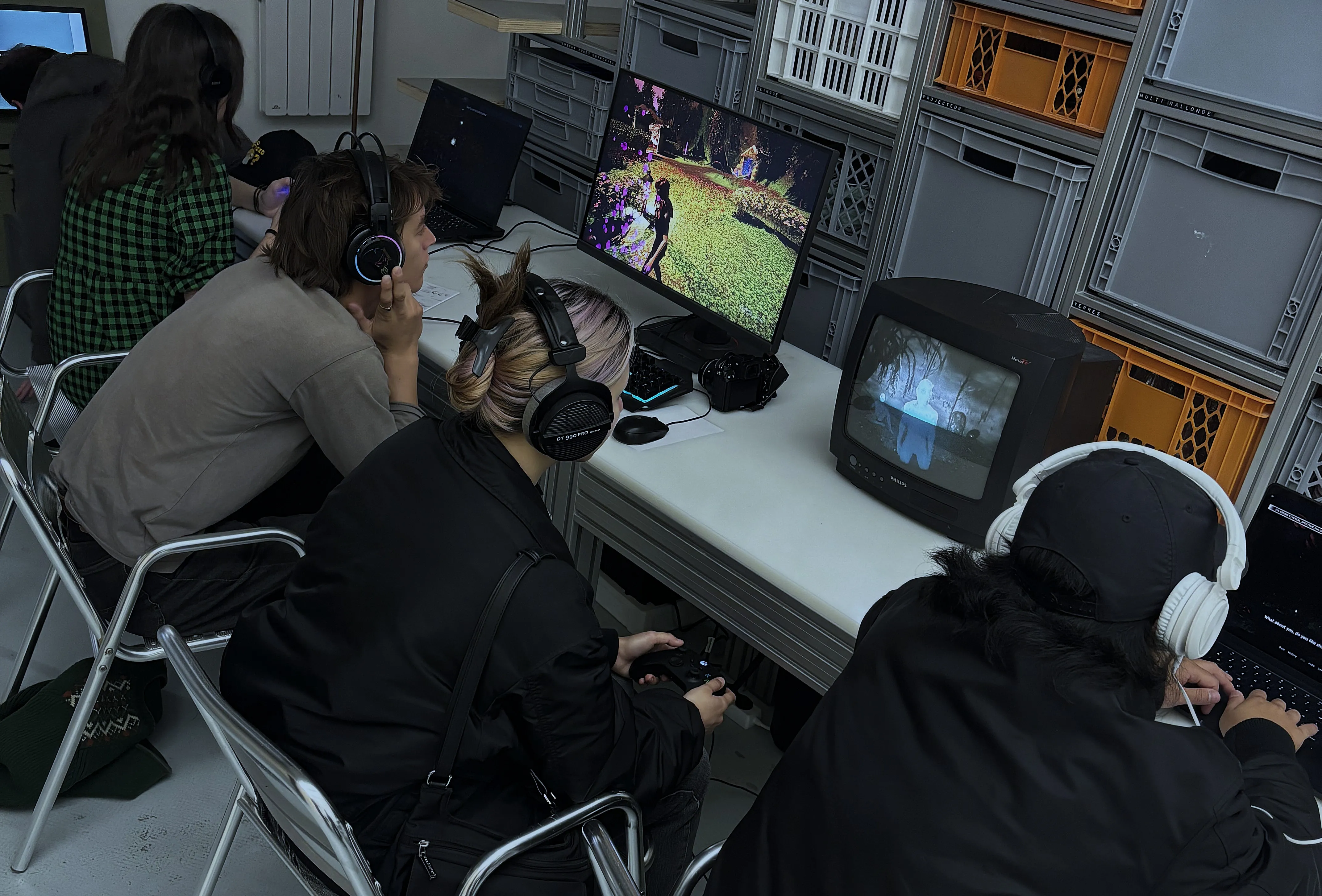
Game session @ Confort Mental
October 2024 / text by Florie Souday and Nino Filiu
To complement Pierre Moulin’s first solo show at the Confort Mental, a game session was organized to exhibit Distraction Collective’s art games. The event highlighted a diverse range of creations by its members, from games developed during game jams to horror experiences and contemplative titles.
- Cache-cache chez Arthur by Stella Jacob
- Cooking For William by Mélanie Courtinat, Nino Filiu, and Pierre Moulin
- Objets d’Outre-Mondes by Alex Sinh Nguyen
- Orobrar by Florie Souday
- Player Non Player by Jonathan Coryn
- The Past I Can Hear by Yatoni Roy Cantu
- The Siren by Mélanie Courtinat
- The Wind Carried It In Its Belly by Pierre Moulin
More than a mere showcase of recent works, the event was also an experiment: how would the parisian contemporary art public react when being presented playable narratives?
There is a fair amount of literature available for art games exhibitions, but they remain pretty rare in Paris: as one of Europe’s “museum cities”, Paris has a massive fine arts heritage that can be seen and felt down to exhibition visitor’s behaviors. Parisians learn very early on that going too close from an artwork usually triggers an alarm because art is old fragile and expensive, so there is a general shyness in parisian’s meandering through art spaces.
Up until the last minute of the show opening, it was still unclear whether or not visitors would even dare to touch the video game controllers in front of the screens. There was non-zero probability that people would use their hands to scratch their chin while looking at the gamepads (as if they were installation pieces), but not use their hands to actually play the games. Fortunately, none of this happened. The game room was basically packed from start to finish, with consoles being more or less played non stop, and people queuing to play them.
Of course there was some quick wins to achieve this, like getting a few members of the collective to play the games when the gallery opens so as to encourage imitation, or curate short games with accessible design; but it also appears that there was something more profound in the psyche of the crowd that allowed for this.
Most visitors were not gamers or art game developers, but they were predominantly young and artists themselves, from which two helpful behaviors are derived. Firstly, they are used to touch art - in a literal sense, thereby easing the transition from a visitor state to a player state. Secondly, as artists themselves, they were used to the position of being the person that creates - rather than the person that views and critiques.
Playing a video game in a gallery setting is challenging for people who don’t feel like they have a creative legitimacy. Playing a game is co-writing the game. Visitors who played The Wind Carried It In Its Belly, a first person walking sim by Pierre Moulin, were effectively the director of photography for a few minutes, since as they were playing they had authority on where the camera should be and where it should point to. A responsibility they had to assume for themselves, but also for the public behind them. That is a fundamental shift in posture from what the contemporary art public is used to.
“But what if I play wrong?” was asked by many hesitant visitors. Accompanying visitors in their transition from passive looker to active agent was paramount to the activation of the public, and giving them agency was the whole point of the exhibition. Player Non Player is a game by Jonathan Coryn filled with storylines and quests, but one player, knowing that full well, decided instead to explore the scenery and make drawings on the grass.
In a way, that is precisely what we want when exhibiting video games in a contemporary art setting. If the public don’t play the games, that means we failed the mediation. If the public play the game right, that means we invited pro gamers that we have nothing to teach to about video games. But if the public play the game wrong, that means that it understood its agency as a player and decided to create something new and personal.